Leatherworking Guild
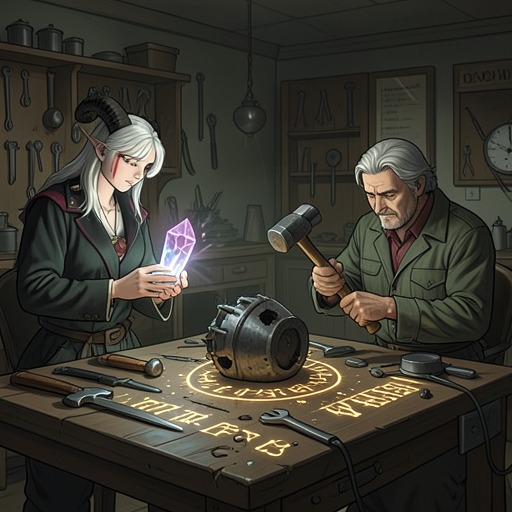
New Life as a Max Level ArchmageThe Leatherworking Guild is a professional craft institution whose highest-ranking intermediary, Stellan, turns a supposedly settled retirement into an extraordinary commission. Its decisive significance lies in the way it connects otherwise incompatible parties: a master craftsman who resists new work, a wealthy demonic client with unusual requirements, and a collaborative project whose intended equipment is deliberately modest in appearance but far beyond ordinary standards. The Guild therefore represents not merely a workplace, but an organizing mechanism that translates private wealth and exceptional power into specialized labor.
Structure and Intermediary Role
The Guild is represented in the relevant episode by Stellan, described as its highest-ranking intermediary. He approaches Rhek at his home even after Rhek has made clear that retirement means accepting no more jobs. Stellan initially respects the practical boundary by offering to remain outside, but he does not withdraw; instead, he presents the Guild’s decision to extend a new offer despite the circumstances. His method is persistent, socially polished, and carefully calibrated. He knows that Rhek’s attention is difficult to obtain, so he releases increasingly compelling details rather than relying on a single appeal.
The Guild’s intervention is institutional rather than merely personal. Stellan explains that a particularly wealthy client has requested Rhek by name, making the commission an official opportunity that the Guild has chosen to convey. This gives the organization power to reopen professional relationships that an individual craftsman might otherwise have closed. At the same time, Stellan’s role resembles negotiation: he frames the offer, anticipates Rhek’s assumptions, and watches for the moment when curiosity overcomes irritation.
The Commission That Breaks Retirement
Rhek initially assumes that the request concerns fashionable or ostentatious armor for a privileged young noble. Stellan corrects that expectation with a far stranger specification: the finished product must be as unassuming as possible, something a silver-rank adventurer could wear without attracting a second glance, while its level maximum is three hundred and eighty-five. The Guild thus serves as the channel through which an apparent contradiction reaches Rhek. The client wants low-profile equipment, but the stated level makes the commission vastly more advanced than ordinary silver-rank gear.
The discrepancy matters because Master Leatherworkers are generally hired for mithril-rank projects at minimum and more often for orichalcum-rank work. Equipment intended for a silver-rank adventurer would ordinarily become obsolete within years or even months, despite the expense of commissioning a master. Rhek therefore recognizes that the request cannot be evaluated by conventional market logic. The Guild’s description transforms an apparently wasteful commission into a technical puzzle, precisely the kind of irregularity that can penetrate his resistance to work.
Stellan then adds that the client wants to collaborate. Rhek treats this condition as nearly intolerable, associating outside collaborators with leeches who use commissions to obtain access to superior craftsmen and improve their own collaborative rank. He can endure mentoring a guildmate, but he dislikes the prospect of working through dozens of projects with an inexperienced helper. Stellan counters with another exceptional fact: the collaborator’s rank will be higher than Rhek’s own. This reverses the normal hierarchy on which Rhek’s objections depend and makes the Guild’s offer more than a simple contract for labor; it becomes a meeting between specialists whose relative positions are themselves unusual.
Materials, Speed, and Client Coordination
After accepting the commission, Rhek provides Stellan with an outrageous list of required materials, expecting the demands to trigger weeks of delay or a request that he become more reasonable. Instead, the Guild contacts him later the same day. The client has already gathered the necessary resources and is traveling to his workshop so the work can begin without delay. The speed of this response demonstrates the Guild’s efficiency as a coordinating institution, while also revealing the client’s extraordinary access to money and rare materials.
Rhek suspects that the resources were purchased rather than personally harvested, since fewer than six hours have passed. He doubts whether every item on the list can have been obtained, especially because some materials may not even be available in Meridian. Nevertheless, the speed and completeness implied by the response impress him. The Guild has not merely found a customer; it has created the conditions for a technically ambitious project to proceed immediately, overcoming the logistical barriers that usually separate a master craftsman from unusual resources.
The organization also supplies the information that identifies the client as Nysari Keresi, a demonic noblewoman. Rhek recognizes the family name as probably important, though not important enough to be familiar to him, since the demon lands are among the few places he has not previously called home. By revealing the client’s identity only after Rhek accepts, the Guild allows the commission to be judged first by its practical terms and only afterward by the social status of the person behind it.
Rhek’s Workshop and the Guild’s Economic World
The episode exposes a broader economic structure surrounding the Guild. Rhek is one of only three Master Leatherworkers in the human kingdoms, and the wealth required to commission him is substantial even before the cost of materials. High-rank craftsmen may possess considerable coin, but advancement beyond rank fifty can force them to purchase ludicrously expensive materials, with no guarantee that the resulting products will repay the investment. Rhek has nearly emptied his bank account through several poorly chosen ventures, showing why commissions and intermediaries remain relevant even to an accomplished master.
Rhek claims that money is not the issue, but his reactions reveal that professional pride and technical interest are inseparable from economic calculation. He is repelled by decorative work commissioned for display, yet he understands that such projects pay for experimental materials. The Leatherworking Guild operates within this tension: it must connect craftsmanship to clients wealthy enough to sustain it, while also identifying commissions capable of appealing to a craftsman who has grown contemptuous of ordinary luxury.
Although Rhek calls himself retired, he has arranged for someone to maintain his workshop every week. The detail exposes the incompleteness of his withdrawal. The Guild’s offer succeeds partly because it reaches a man who has abandoned active commissions in words but not in infrastructure. When he arrives at the familiar workshop in the Crafter’s District, Nysari Keresi is already waiting outside. The Guild’s work has therefore moved the commission from an abstract proposal to a prepared physical encounter, with the workshop preserved as the material center of Rhek’s professional identity.
Significance Within a Network of Systems
The Leatherworking Guild belongs to a world in which institutions, machines, magical interfaces, badges, and materials all participate in practical action. Elsewhere, the armored Convoy carries passengers through monster-infested territory, with thick plating and mana-powered artillery; power cores are drawn into artificing slots and restore the train by transferring energy through its systems. Guild buildings likewise obey System-mediated rules: upgrading a guild tier expands its interior while preserving a relatively small exterior, and inactivity can lead to eviction. A guild quest can even ignite in golden fire when the System recognizes a valid signature, confirming the restoration of Vanguard to tier one and reopening access to facilities such as workshops and a vault.
Against that background, the Leatherworking Guild is best understood as one node in a larger network rather than an isolated bureaucracy. Stellan’s authority, Rhek’s rank, Nysari Keresi’s wealth, the workshop, the material list, the System’s progression rules, and the resulting armor all cooperate to produce an outcome no single participant could easily achieve alone. The Guild translates a client’s unusual desire into a negotiable brief, translates Rhek’s resistance into curiosity, and translates rare resources into a possible crafted object.
Its importance is consequently practical and thematic. The Guild does not abolish hierarchy; it depends on rank, wealth, reputation, and specialized access. Yet it can also rearrange those hierarchies, presenting Rhek with a collaborator ranked above him and a commission whose low visible status conceals an extraordinary technical ceiling. In the same manner that a small guild building can contain a much larger interior, the Guild’s apparently ordinary professional function contains a far more expansive structure of power, labor, technology, and exchange.